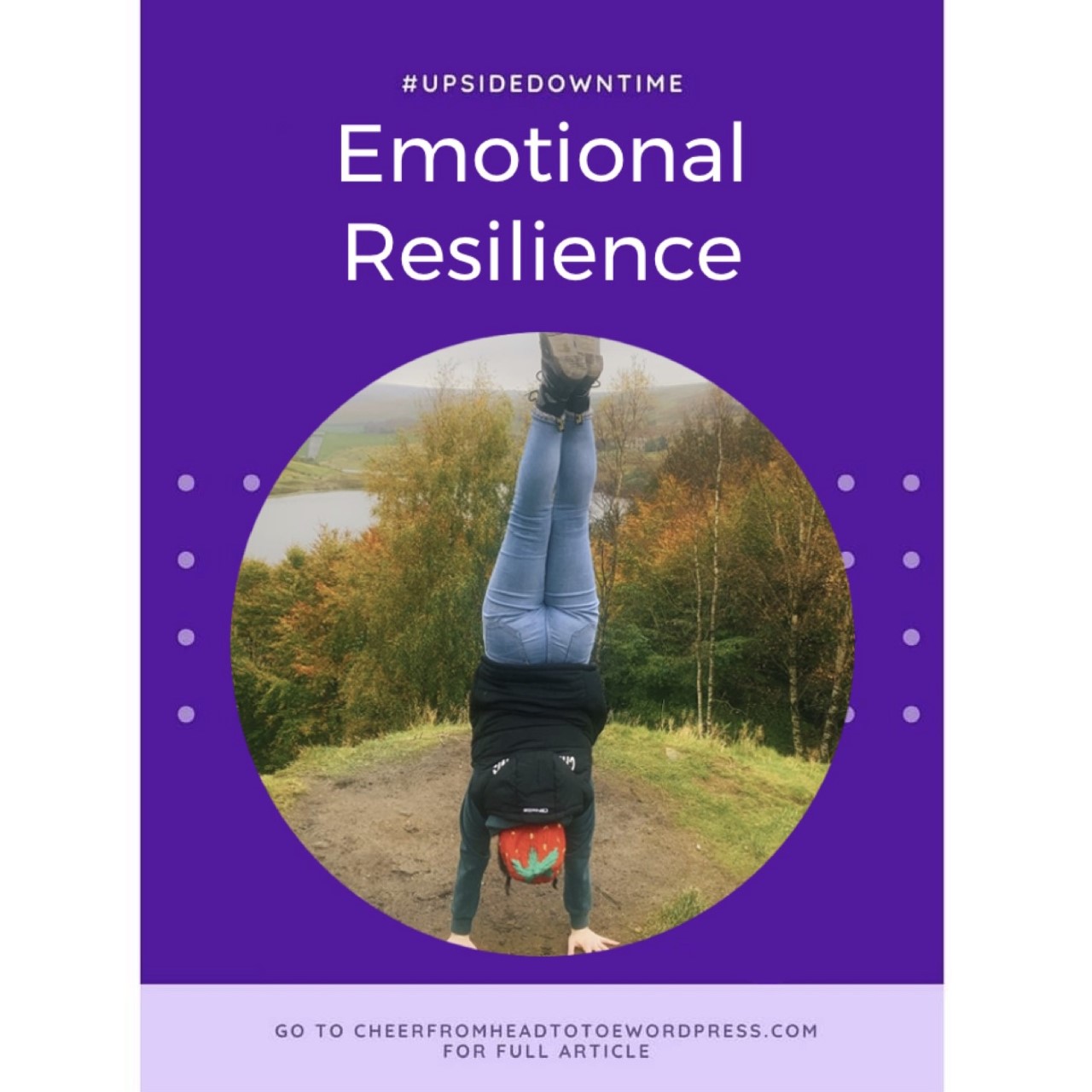
Happy October – between local lockdowns, tiered lockdowns and circuit break lockdowns, spooky season if definitely upon us.
In this month’s
Upside-Down-Time’s feature
I wanted to talk about emotional resilience, and the huge part it plays in dealing with our emotions. So, what is emotional resilience? You know when you’re an infant, and people say it’s good to play outside in the mud, to build up your immune system? They want you to be in school and pick up the sickness bugs from a young age, because apparently this will build your tolerance and you won’t catch a bigger bug later on in life. Now I have no scientific evidence to back that up, but that’s what we say, isn’t it? Those experiences are said to build up our immune system’s resilience. Do you see where I’m going yet? Emotional resilience is similar. However, it’s not so much WHAT we experience, but HOW we experience, and how we deal with that experience.
Emotional resilience is a protective factor for things like low mood and depression
. So it’s a skill well worth having! What’s different about the example I gave earlier, is that when it comes to emotional resilience, the more trauma you experience doesn’t necessarily mean you will have more emotional resilience. It’s how you deal with that trauma. Let’s use the example of a romantic relationship breakdown – in layman’s terms: you’ve been dumped.
Example 1, Alex’s break-up:
Alex gets dumped by someone they believe to be the one, the love of their life, their soulmate. Alex is so upset and can’t stop crying. The days turn into weeks and everything they see or do reminds them of their ex, so Alex begins to withdraw from friends, family, and usual hobbies. Alex believes nothing will ever be the same, and that they will never be as happy as they were with their ex. Alex blames themself for the breakup and all they can think about is pointing out their flaws. Alex doesn’t ever want to feel this way again, so anyone that comes close, Alex pushes them away to avoid what they believe to be the inevitable.
Example 2, Sam’s break-up:
Sam gets dumped by someone they thought could have been the one. Sam is upset and takes the time to feel those emotions and cry it out. It’s difficult for the first few weeks, but as tough as it is Sam makes plans with friends and family to distract themself. Sam knows that they may be a little distracted at training, but it’s the best thing for them to keep busy. Things may not be rosy right now, but life goes on and Sam starts to feel a little happier again. Sam still feels sad about the relationship every now and again, but they appreciate the relationship for what it was, and know that better things are coming.
Who shows more emotional resilience?
Don’t get me wrong, I have absolutely been an Alex before, on more than one occasion, you can’t get it right every time. Put it this way, if you act like Alex after every break-up, 2-3 partners down the line you’re going to feel really bad about yourself and your self-esteem will be really low. If you’re more optimistic and act like Sam, your wellbeing will be in a much better place. Optimism isn’t about being positive 100% of the time. Optimism is recognising and accepting that both positive AND negative situations are a part of life.
Think of it like jumping. You can do a toe touch 100 times and it can still resemble a star jump. If you want hyperextended toe touches, you have to look at it differently, you have to tweak your technique. We know that practise doesn’t make perfect, practise makes permanent. In order to get perfect (which doesn’t exist by the way), you have to alter your technique or your thought processes in order to benefit.

And this is something really relevant to the climate we’re living in. Covid sucks, lockdown is awful, social distancing is boring. The coronavirus restrictions are ruining everyone’s plans. Nobody wants this to happen, nobody benefits here (unless you bought shares in anti-bacterial hand gel just before this all hit). In times like this it’s easy to focus on the things we can no longer do, I can’t stunt, I can’t hug my niece, I can’t dance the night away in a club or catch a show in a theatre. With all that being said, I can still eat my favourite foods, I can still speak to my favourite people, albeit online, and how pretty are the colours of the leaves right now? I can think all of those things, the good and the bad, and still be optimistic.
The key to optimism in difficult situations is having something to look forward to. Make sure to pencil in an activity every so often, it doesn’t have to be huge. One of our biggest assets as humans is that we can adapt. Can’t see family? We can videocall. Can’t go to the cinema/theatre? Movie night at home. Can’t stunt? Work jumps, tumbles, flexibility, strength and conditioning. Walks in nature, baking, home-cooked meals, dancing, laughing, the list goes on.
The key takeaway of this article is that life comes with both good and bad experiences. Whilst sometimes we can’t control the negative experiences that come our way, we can control how we respond and adapt. Our outlook on the situation is the key to strengthening those resiliency skills. As I mentioned earlier, emotional resiliency is a protective factor against a life of shame and low mood. And to avoid feeling like you’re constantly living on that hamster wheel, remember to schedule in those little activities that you can look forward to each week.
To help you practise emotional resilience, here’s October’s mindfulness exercise of the month:
As always, this may not be the exercise that works for you. Everyone is different, but I would always recommend giving it a go during a time when you’re feeling relatively neutral to begin with, so you can get used to it. Then give it another go when you begin feeling overwhelmed. If it helps, fantastic! If it doesn’t help, you can move onto a different exercise.
To start, get yourself into a comfortable position. Perhaps sitting or laying down. Close your eyes or rest them by relaxing and focusing on a spot in the room.
Visualise yourself beside a gently flowing stream with leaves flowing along the surface. Notice the colours, the sounds, the breeze perhaps.
Take a few minutes to notice each thought that comes into your mind, and place that thought on a leaf. Let the leaf float down the stream. Whether the thought is pleasurable, painful, or perfectly neutral, place them each on a leaf and watch them float by.
If your thoughts stop, peacefully continue watching the stream until new ones enter your mind.
Allow the stream to flow at its own place. Don’t let the speed of your thoughts alter the speed of the stream. You’re not trying to rush your thoughts away, you’re allowing them to happen, to come and go at their own pace.
If your mind begins to think “this is silly”, “I’m bored” or “I’m not doing this right”, place those thoughts on a leaf too, and watch them float by.
If a leaf gets stuck, let it hang around until its able to pass on by. If the same thought pops up again, watch it float by another time.
If a difficult or painful feeling arises, simply acknowledge it. Say to yourself “I recognise myself have a feeling of frustration/boredom/hurt”. Once again, place that thought on a leaf and allow it to pass by.
From time to time, your thoughts may distract you from being fully present in the exercise. This is normal. As soon as you notice that happening, bring your attention back to the stream and to the exercise.
Continue doing this exercise until your mind feels a little more at ease, and you feel able to go on with your day.
If your team or yourself have done something amazing you need to nominate them for #CFHTTFridayaward
As always, we’d love for you to be involved in our Upside-down-time feature. If you’re reading this on a mobile device, screenshot the article and tag us on Instagram, Facebook or Twitter. If you want to be featured next month, post a photo or video of yourself upside-down (e.g. handstands), tagging #upsidedowntime and #CFHTT.
Lastly, we want to hear your NOMINATIONs for someone who has gone above and beyond for their team, charity, etc. This can be yourself, teammates, coaches or cheer-parents! Message us with any nominations you have!
Ta’ra for now!
Rachel x

97% of people who follow CFHTT website enjoy following our social media platforms
@Cheerfromheadto
Discover more from The UK's number one Cheerleading Blog
Subscribe to get the latest posts sent to your email.
