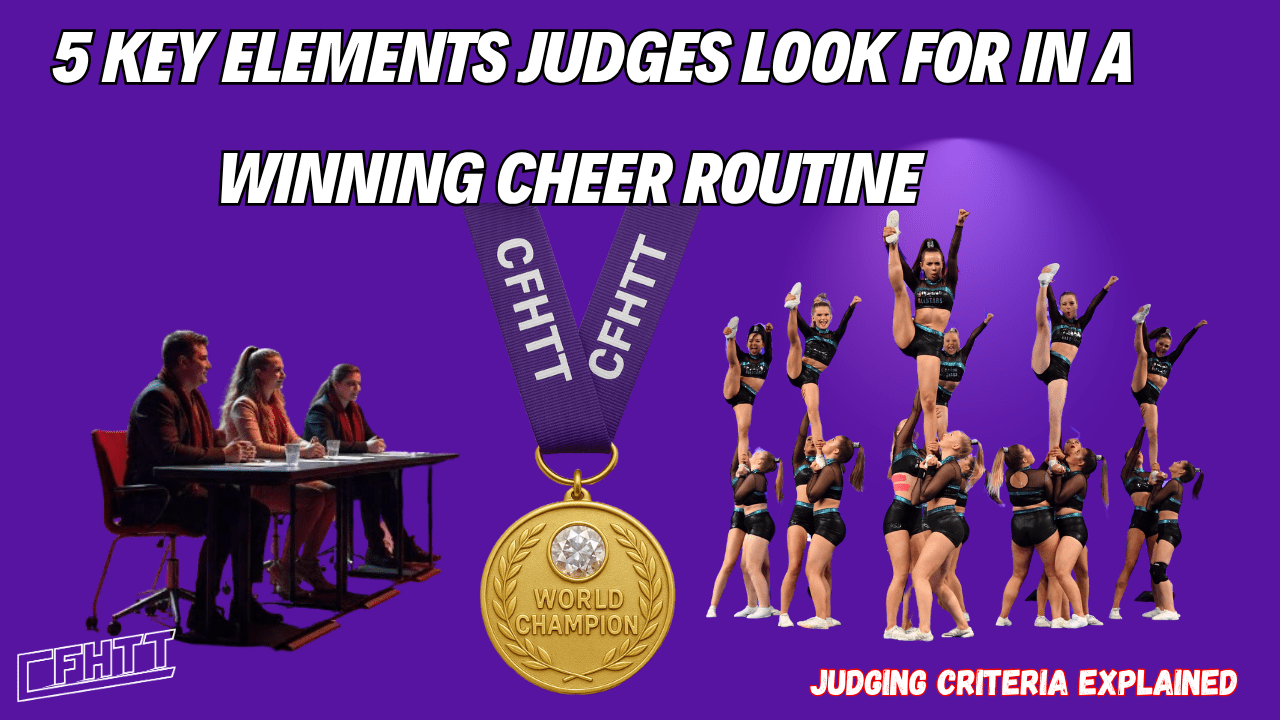
The 5 Criteria Judges Really Care About
I’ve spent over a decade immersed in the cheerleading world. I have studied judging rubrics and interviewed elite coaches. I have also analysed championship-winning routines.
What I’ve learned is simple:
Winning routines aren’t just clean they’re strategic, intentional, and ruthlessly built around the scoresheet.
Whether you’re a seasoned coach or new to the mat, this guide is packed with practical tips. You’ll find insider insights to help you level up your routine. These tips will help you hit the scoresheet hard.
Before you continue on reading Is Your Cheer Routine Competition Ready? let me introduce myself.
Cheer From Head To Toe (CFHTT) was the first platform to truly champion UK cheerleading online. Founded by a recognised expert, CFHTT has been leading the way since 2011. It has become the trusted go-to for UK cheer coaches looking to stay ahead of the curve.
With tried-and-tested strategies, competition insights, and up to date guidance, we’re here to support your journey on the mat. We’re also here to support you off the mat.
If you want to learn more about UK cheerleading make sure you subscribe to a newsletter
Subscribe
subscribe to CFHTT on the blog for exclusive cheer news, resources, and behind-the-scenes coverage you won’t want to miss. We’re here to make sure the UK cheer community stays seen, supported, and celebrated 💜.

Ongoing discussions about scoring systems
Before diving into this article, Cheer From Head To Toe (CFHTT) wants to highlight the ongoing discussions about scoring systems. These discussions are occurring within the UK cheerleading community. We are aware that changes and adaptations are taking place. In particular, there is a focus on implementing a United Kingdom version of the United Scoring System. This article is based on information available at the time of publishing and is subject to updates. We urge you to visit the official website of each event provider. This will give you the most current scoring policies and competition updates.
As an authoritative source in the UK cheerleading community, CFHTT is committed to helping coaches, athletes, and supporters stay informed. Understanding which scoring system is used at which competition is crucial for routine preparation and competitive success.
UK Cheerleading Event Providers & Their Scoring Systems (2025–2026 Season)
Below is a list of event providers and the scoring system they are currently using as of publication. Please note: this is subject to change, and discussions about unifying or modifying scoring systems in the UK are ongoing.
📊 UK Event Providers & Scoring Systems (2025–2026 Season)
| Event Provider | Scoring System Used |
|---|---|
| Legacy Cheer and Dance | UK Version of the United Scoring System |
| 21st Century Cheer | UK Version of the United Scoring System |
| Showdown Elite Events | UK Version of the United Scoring System |
| Power Up: | UK Version of the United Scoring System |
| Future Cheer | UK Version of the United Scoring System |
| Cheer City | UK Version of the United Scoring System |
| Cheer Revolution | UK Version of the United Scoring System |
| Energy Events | UK Version of the United Scoring System |
| ICE (Incredibly Cool Events) | UK Version of the United Scoring System |
| British Cheerleading Association (BCA) | Hybrid version of the IASF Comparative Scoring System |
| ICC (International Cheer Coalition) | World Cheerleading Coalition (Aligns with IASF Scoring System) |
| Scottcheer | IASF Scoring System |
| UKCA (UK Cheerleading Association) | Bespoke Scoring System |
| Soar Cheerleading | Hybrid version of the IASF Comparative Scoring System |
If there’s an event provider not listed that you’re curious about, please leave a comment below. You can also message us directly.

Let’s dive deep into the five core areas judges are truly scoring. We will provide insider insights. These insights come with actionable steps you can use to level up your team’s next performance.
1. Intelligent Preparation: The Quiet Key to Big Success
At CFHTT, we consistently see coaches making the mistake of entering divisions without truly assessing whether their athletes are ready.
Before you even put a routine on the floor, you need to do your homework.
✅️Understanding the division, the scoresheet, and the rules isn’t optional it’s essential.
✅️Smart coaches build routines that match their athletes’ current abilities, not their wish list.
✅️ Start by watching teams in your division️ and see what the general skill level looks like.
✅️Then decide honestly: Should my athletes be competing in this division ?
✅️This requires honest evaluation, rigorous understanding of the scoresheet, and early strategic planning.
Once you’ve chosen the right division.
✅️Study the scoresheet like your season depends on it because it does.
✅️Pay very close attention to the rules and event provider’s scoresheet for each competition you attend. These can vary from competition provider to provider.
✅️In cheerleading, the rulebook and age grid aren’t just complicated. They evolve every year. Pay attention to the details.
💡 CFHTT Tip:
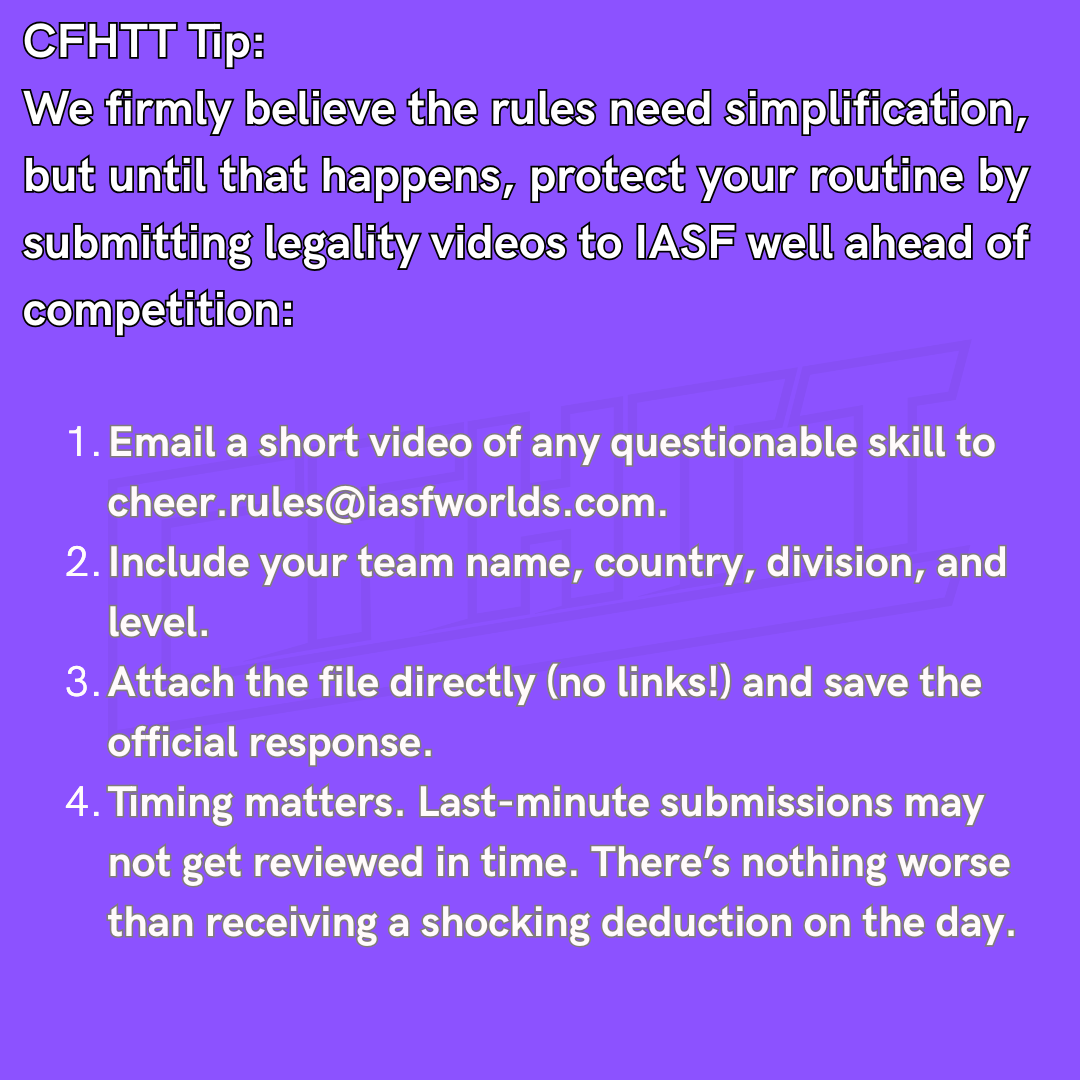
Many competition providers state on their websites that they welcome questions about their rules and regulations. If you’re unsure about any part of the scoring system or rulebook especially early in the season when your routine is nearly finalised don’t hesitate to reach out. As a paying or prospective customer, you’re entitled to clarity. Event providers are there to support you, so make use of the service they offer. Clear communication now can save you from costly deductions later

This preparation extends far beyond skills:
✅️Are you fluent in the latest rules and legality updates?
✅️Have you cross-checked every stunt against the current rubric, not last season’s?
CFHTT coaches treat the rulebook as a strategic playbook, not a last-minute check.
2. Technique: Where Execution Becomes Excellence
In today’s UK cheerleading world, difficulty without control no longer wins.
Technique is the backbone of cheerleading and it’s non-negotiable at the competitive level.
Judges are trained to look for safety and technique first across stunts, tumbling, pyramids, jumps, and dance.
Sloppy skills, even if they’re hard, will cost you major points. Judges can only mark what they can cleanly see. They cannot mark what you are trying to show.
CFHTT Perspective on UK Cheer Evolution:
Years ago, UK cheerleading often rewarded risky difficulty over safe technique. Skills were performed with passion. However, there was little precision. Coaches were self-taught from grainy You Tube videos. No formal education was available.
Today, the landscape has evolved. Judges and the industry at large prioritise
✅️ clean body position
✅️ synchronisation
✅️stability
✅️safety
✅️ true showmanship.
💡 CFHTT Tip:
Smart coaching today means mastering existing skills rather than chasing harder ones too soon.
A cleanly hit, safe routine builds team confidence. It also boosts athlete pride. A messy, stressful routine damages self-esteem. It heightens competition day anxiety.
CFHTT
Common Mistakes We See:
✅️Misinterpreting Skill Terminology: Gym terms like “rebound” or “tic-tock” don’t always match how the rulebook defines them. Know the official language by studying the Glossary.
✅️Assuming Past Legal Skills Are Still Legal: Rules shift yearly. What was fine last season may now be illegal.
✅️Copying Higher-Level Skills: Just because it looks cool at Level 5 doesn’t mean it’s legal at Level 2. Always cross-check.
3. Synchronisation: The Silent Secret to Winning
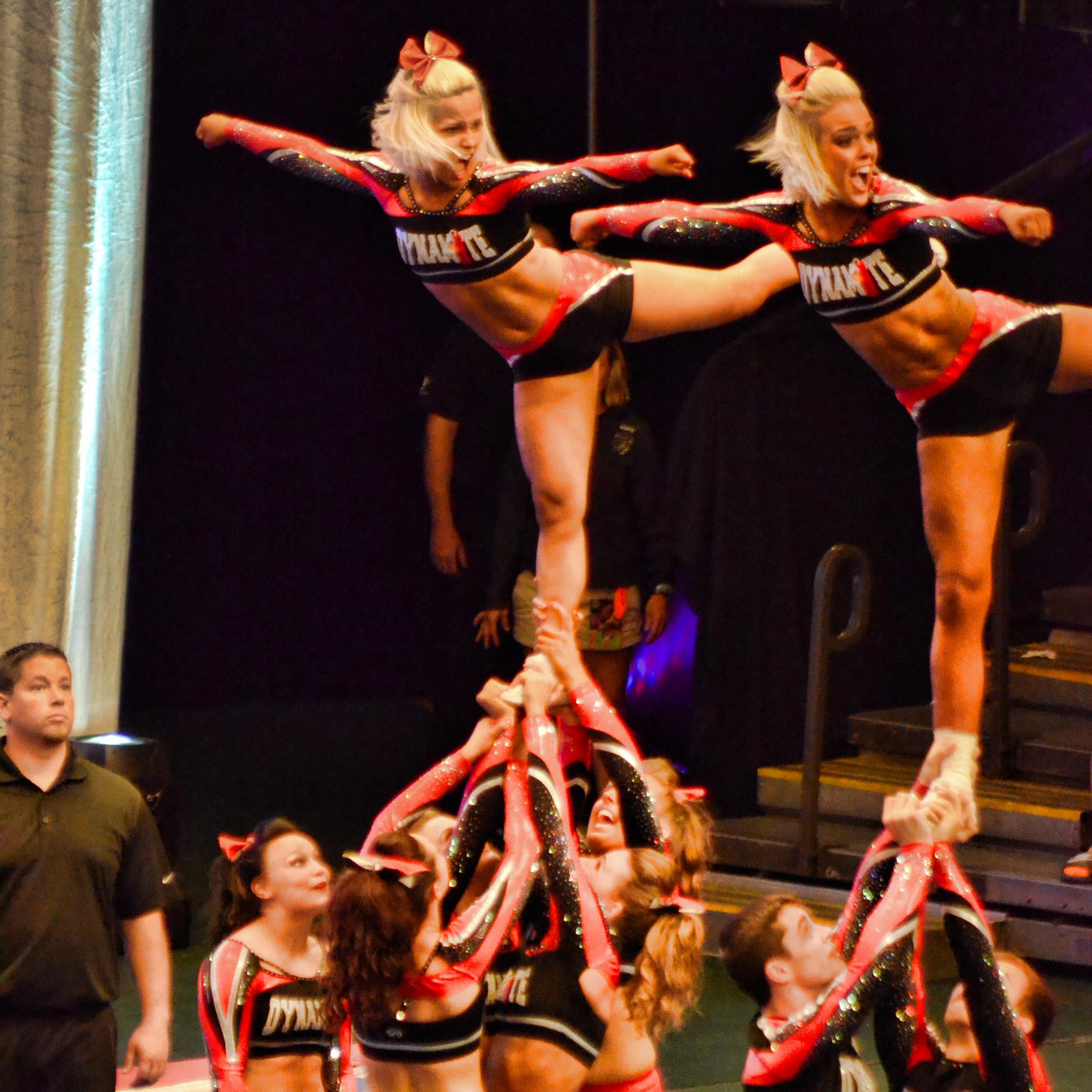
Cheerleading is not just about individual skills , it’s about moving as one unit, like a hive mind.
As a cheer expert, I can usually tell after the first stunt sequence whether a team will score highly. I do this simply by watching their opening sequence.
✅️ If synchronisation is off early, it’s a sign the athletes lack full confidence in the routine.
When a routine is tightly synced, it becomes magnetic just like a musical production where every dancer hits their mark. It creates that elusive “wow factor” that leaves judges and audiences in awe, sending a message that: “This team is trained, disciplined, and confident.”
CFHTT
💡 CFHTT Tip:
As a coach, synchronisation must become a non-negotiable standard at every practice.
It’s not enough to only say “hit your counts.” Athletes must understand that perfect timing is their responsibility for the team’s success.
Perfect timing enhances everything: jumps look higher, stunts seem cleaner, and choreography feels more impactful.
4. Performance & Showmanship: Sell Every Second
Technical skills are the bones of your routine but performance is the soul.
Your stunts may be difficult, and your pyramids intricate. However, if your athletes aren’t performing with full energy, confidence, and connection, your scores will suffer.
At CFHTT, we believe what separates a good routine from a great one is showmanship.
It is so frustrating when a team performs immaculate skills with no hint of a smile.
Judges aren’t just scoring they’re watching a show so make sure you entertain them.
At Cheer From Head To Toe, we train coaches to embed performance into every practice:
✅️From the very first motion to the final pose, your athletes must perform with energy, passion, and personality.
✅️Great performances don’t just earn points they inspire emotions. And routines that inspire always score higher.
Showmanship can be taught
While showmanship is often seen as natural charisma, it can absolutely be choreographed. With intentional planning and rehearsal, you can build engaging and visually appealing routines. These routines leave a lasting impression and boost your showmanship scores.
Key Coaching Points for Showmanship:
✅ Set realistic expectations.
As a coach, your job is to help athletes perform at their best. Recognise what they can realistically achieve in their routine.
✅ Teach showmanship like any other skill.
Not all athletes are born performers. Expecting Broadway-level charisma from the start is unrealistic showmanship must be taught and drilled until it becomes muscle memory.
✅ Use intentional choreography.
Plan for eye contact, purposeful movement, and engagement moments throughout the routine. Don’t leave showmanship to chance.
✅ Communicate effectively.
Do your athletes respond to tough love or encouragement? Confidence grows when athletes feel safe and supported.
✅ Confidence leads to performance.
Athletes perform better when they trust their coach. Showmanship isn’t just facials. It’s movement with purpose, standing tall, and owning the floor.
Expectations vs Reality
✅ Know your team.
Don’t choreograph a routine you wish your athletes can handle. Choreograph for what they can actually perform with confidence and power.
✅ Highlight strengths.
Blend challenging choreography with skills your team can execute consistently and energetically.
Use the Spotlight Wisely
✅ Spotlight charismatic athletes.
Most teams have at least one or two athletes who naturally shine. Use them strategically during key moments to elevate the whole routine.
✅ What is a spotlight?
It’s when you highlight a skill or moment. For example, one athlete performs a specialty skill while others transition. This is done to enhance visual impact.
💡 CFHTT Tip:
Endurance training is essential to ensure athletes can perform full-out until the final pose.
A fatigued, expressionless team may hit skills but still lose crucial points in Overall Impression.
💡CFHTT Bonus Insight:
Judges can feel when athletes are struggling. Anxiety is contagious and when judges are holding their breath in worry, your score is already dropping.
You want judges leaning forward in excitement, not bracing for a fall.
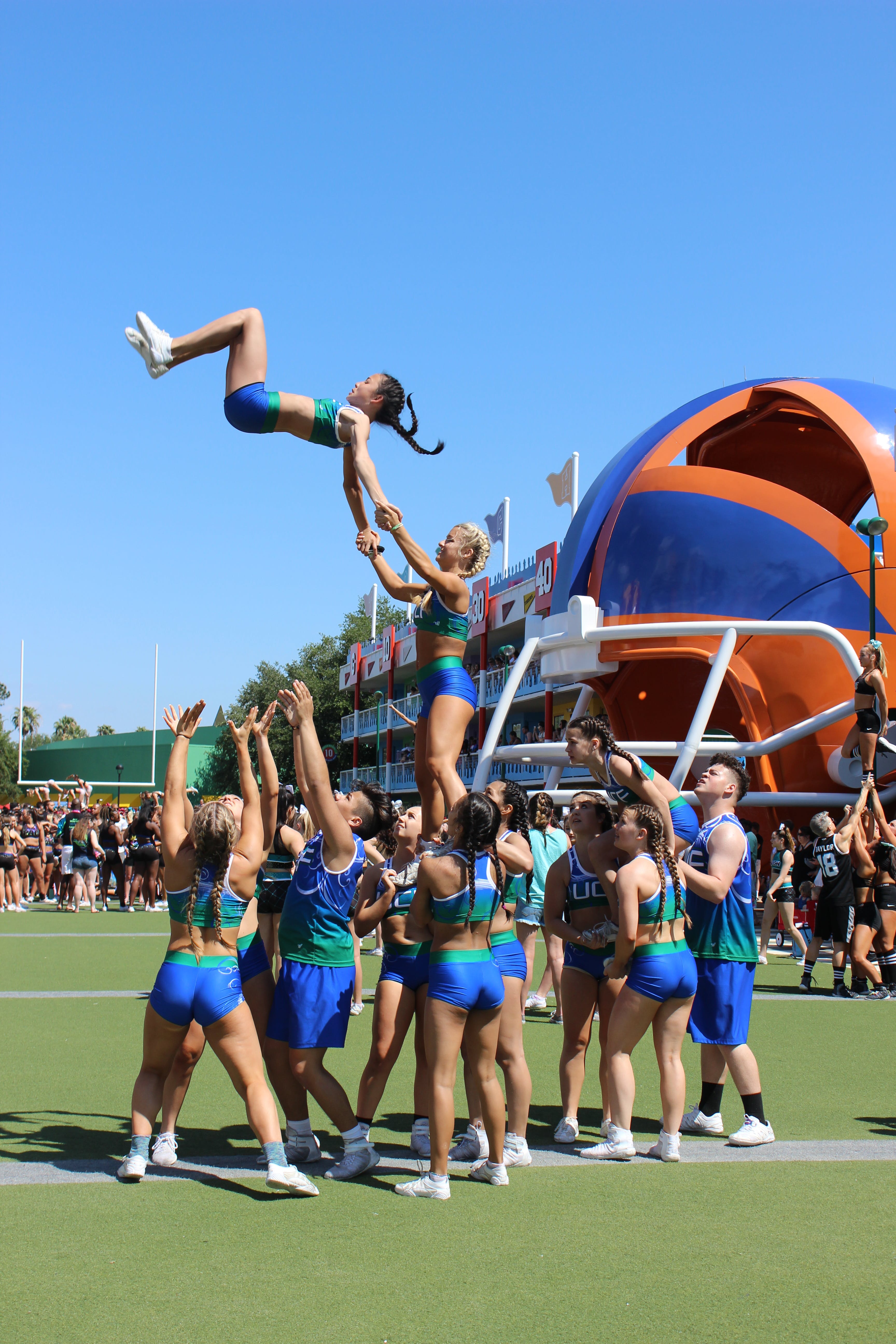
5. Difficulty: Smart Difficulty Beats Reckless Difficulty Every Time
Gone are the days when harder always meant better.
✅️Today, smart difficulty wins: skills that push limits without sacrificing execution.
As early as 2015, major competition bodies started prioritising clever, innovative difficulty over blind ambition.
It’s not about cramming in elite skills it’s about showcasing what your team can do perfectly.
👉 A major fall or series of bobbles will destroy your Difficulty score and Execution score simultaneously.
Be strategic. Choose the highest skills your team can hit flawlessly.
A Good Example:
Zodiac Allstars, now known as Top Gun Allstars UK, are a great example.
They built an internationally renowned gym that has won every title possible and even scored 100% of the scoresheet, a feat never done before.
They understood their athletes’ strengths and strategically crafted their programme to nurture that skill set.
Final Reflections: Are You Coaching to Win or Hoping to Score?
Teams that succeed are led by coaches with a clear understanding. They know that routines must be intentional. They are strategic and built for both the athlete and the judge.
✅️They don’t rely on hope.
✅️They don’t guess if a skill is legal.
✅️They don’t cross their fingers on competition day.
✅️They plan every eight-count with precision.
✅️They train every execution with discipline.
✅️They coach every performance with pride.
If you’re unsure where your routine stands, ask yourself:
- Would I score this routine highly if I were a judge?
- Are my athletes ready to perform under pressure and bright lights?
- Does this routine tell a compelling story or just show off disconnected skills?
If you want your routine and your athletes to rise to the top, start by elevating your approach.
Be the coach who leads with intention, preparation, mastery, and heart.
Because judges don’t just score skills they reward teams that demand excellence in every moment.
🟣 Click here to view the full list of UK and Ireland Cheerleading Competitions for the 2025–2026 Season

CFHTT, write every article with the aim of supporting and uplifting the UK cheer community. If you find it helpful, please share it with other coaches. Together we can raise the standard. We can share knowledge and make our sport even stronger. 💜
Subscribe now and enhance your cheerleading skills today!
Discover more from The UK's number one Cheerleading Blog
Subscribe to get the latest posts sent to your email.
