
SportCheer England has won recognition.
After years of work, cheerleading in England has both recognised sport status and a formally recognised National Governing Body of Cheerleading.
That deserves celebrating.
But the more important question is: what does recognition allow the English cheerleading community to do next?
And the even bigger question:
What will SportCheer England do with that recognition?
From fighting for recognition to deciding what to do with it
This milestone did not happen overnight.
SportCheer England was incorporated in January 2017, and the journey towards recognition has involved years of governance work, policy development and building the structures expected of a National Governing Body. Much of that work has been carried out by volunteers alongside their professional and cheerleading commitments.
That context matters.
The announcement may have arrived in one day, but the work behind it definitely did not.
The first major breakthrough
The first major breakthrough came in March 2025, when cheerleading was formally recognised as a sport. At that stage, SportCheer England was still working towards NGB recognition. Now that second piece is in place. The conversation therefore changes.
What matters now is what the recognition makes possible.


Recognition opens doors. It doesn’t guarantee what comes through them.
This is where SportCheer England’s latest explanation is important.
Following the announcement, SCE outlined some of the opportunities it believes recognition could create.

That progress should be celebrated.
These include greater opportunities for affiliated clubs to access funding programmes, stronger applications for facility development, closer relationships with schools, universities and local authorities, further development of coach education and safeguarding, and a stronger voice in national policy.
There are potentially longer-term opportunities too, including conversations around educational pathways and the future development of cheerleading within education.
That is substantial.
But SportCheer England has also been careful not to promise overnight transformation.
Recognition creates possibilities, not guarantees.
When CFHTT asked SportCheer England what the first practical difference could be for coaches and grassroots clubs, Chair of the Board Joey Gamper Cuthbert pointed to access to funding:
“While cheerleading’s formal recognition as a sport was gained last year, Sport England emphasised to us that until NGB recognition was also achieved, the sport status alone didn’t have much value. This is because they consider cheerleading to be a ‘high risk’ sport, and without governance and regulation to support it, many doors would remain locked.
“A practical example of this is access to local authority funding: Local councils typically ringfence their sport funding for clubs who are members of a Sport England recognised NGB. This is done to ensure that the money is given to clubs where there is a clear channel of accountability to meet certain standards (qualified, DBS checked staff, insurance etc) and where, should something go wrong, there is a clear route for escalation to a governing body.
“So, one immediate and practical difference will be access for member clubs to apply for ringfenced local sports funding. We’ve also heard from clubs where membership of a recognised NGB has been a requirement of their local authority to access capital funding for premises and building development/change of use. Successful access to those types of funds will provide a significant injection of tangible support to the cheerleading community.”
— Joey Gamper Cuthbert, Chair of the Board, SportCheer England
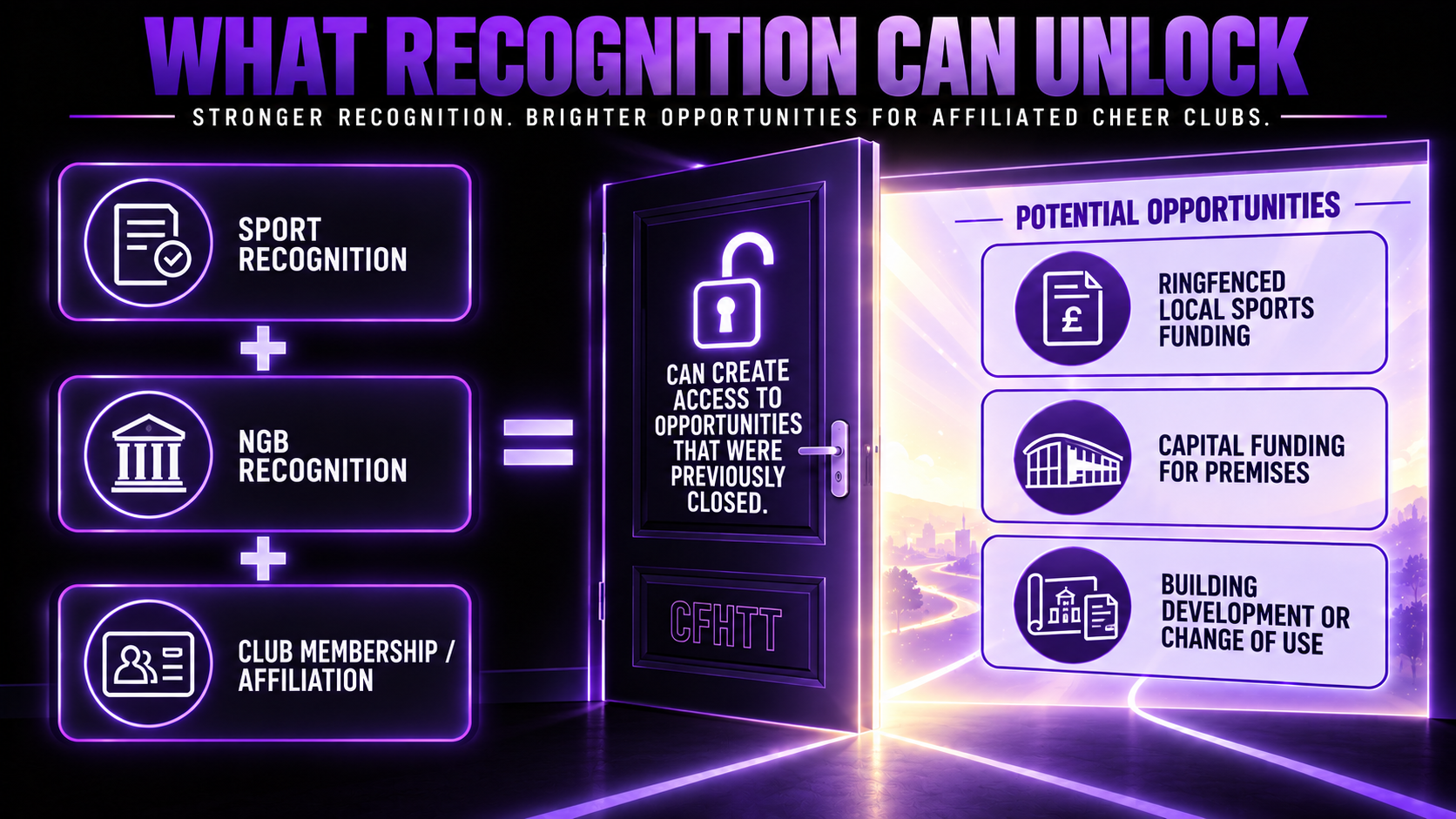
Sport recognition + NGB recognition + club membership/affiliation can create access to opportunities that were previously closed.
It does not mean every application will be successful. Funding will still have its own eligibility criteria and application processes.
But for some clubs, being able to apply in the first place is the change.
And that brings us to the bigger question: if new funding opportunities become accessible, where could that investment have the greatest impact on the future of English cheerleading?
For coaches, this needs to become tangible
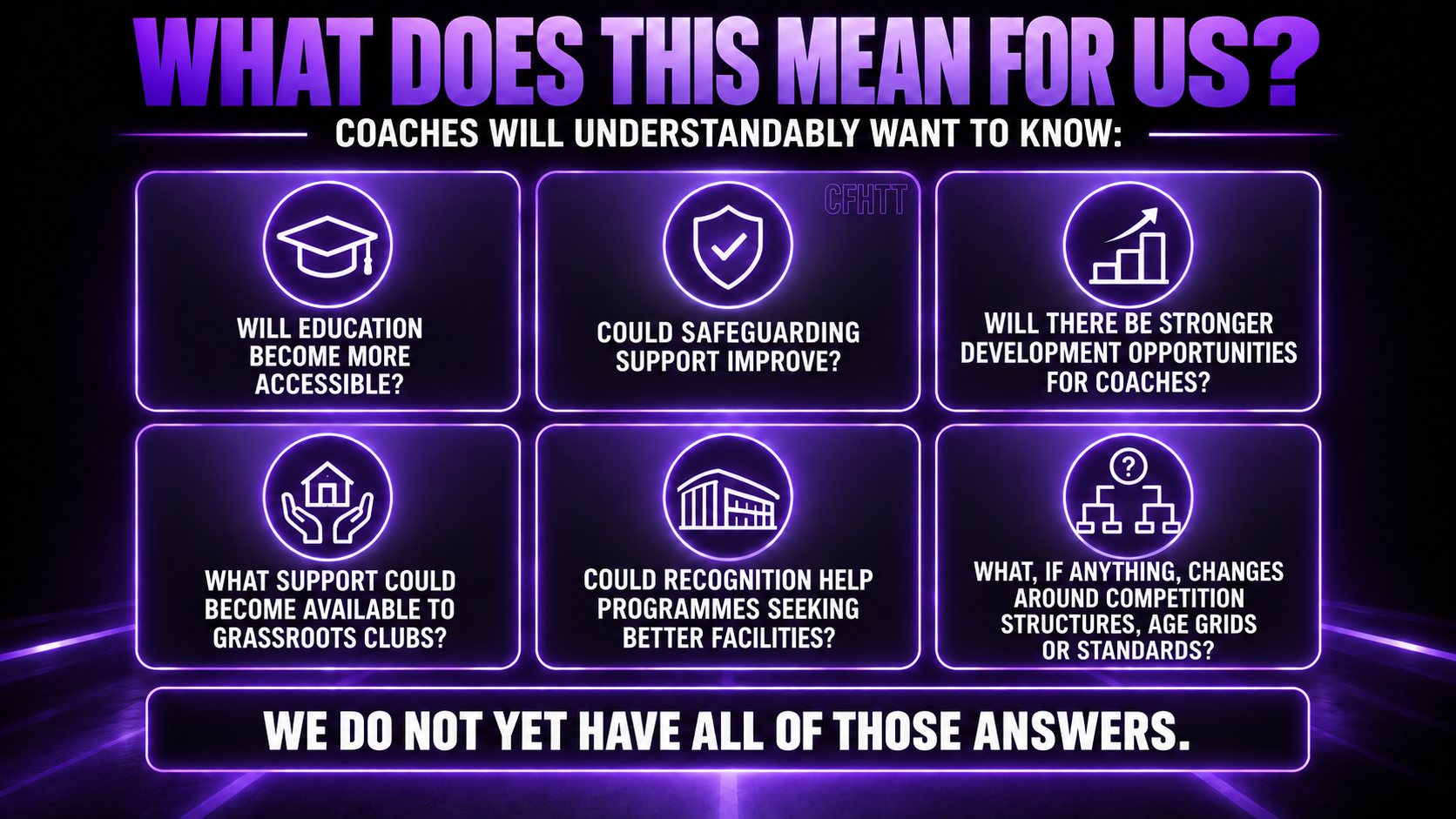
Governance can feel distant from what happens inside a cheer gym on a Tuesday evening. That is why coaches will understandably want to know. What does this mean for us?
- Will education become more accessible?
- Could safeguarding support improve?
- Will there be stronger development opportunities for coaches?
- What support could become available to grassroots clubs?
- Could recognition help programmes seeking better facilities?
- And what, if anything, changes around competition structures, age grids or standards?
We do not yet have all of those answers.
SportCheer England has said it plans to produce a comprehensive FAQ following discussions with Sport England, covering what recognition means in practice, what changes immediately and which opportunities may develop over time.
We can’t wait to read it.
It also means coaches should be cautious about assuming that NGB recognition automatically changes the competitive landscape.There is no reason, based on what has currently been announced, to assume that scoresheets, age grids or the way every event provider operates will suddenly change. As this new phase develops, clear communication will be essential. Coaches should be able to understand what affects them without having to decipher sports governance themselves.
The opportunity is bigger than competition season
One of the most interesting consequences of recognition may happen away from the competition floor. SportCheer England says its new status gives cheerleading a stronger platform from which to advocate nationally, build partnerships and contribute to conversations where decisions affecting sport are made.
That matters.
During the Covid-19 pandemic, for example, SCE has highlighted how cheerleading’s lack of recognised sport and NGB status limited its place within government and Sport England Return to Play discussions. That illustrates what recognition can change. A recognised governing body gives cheerleading a formal voice within a much larger sporting system. And that system includes schools, universities, local authorities, funders, facilities, government and other sporting organisations. For a sport that has spent decades building much of its infrastructure itself, that could ultimately prove more significant than any single immediate announcement.
But where will the investment go?
This is where I think the next conversation needs to happen. English cheerleading has an increasingly visible elite pathway. I want to see Team England continue to succeed. I want our best athletes to have strong development pathways and the opportunity to compete internationally.
But elite success cannot exist independently of grassroots access.
Every elite athlete starts somewhere.
- A recreational class.
- A local programme.
- A coach who spots potential.
- A family discovering cheerleading for the first time.
And this is why recognition should not only be viewed through the lens of what it can do for athletes already approaching the top of the pathway. We also need to ask what it could do for the child who has not entered the sport yet.
For me, the relationship is simple:
- Funding creates access.
- Access creates participation.
- Participation creates development.
- Development creates opportunity.
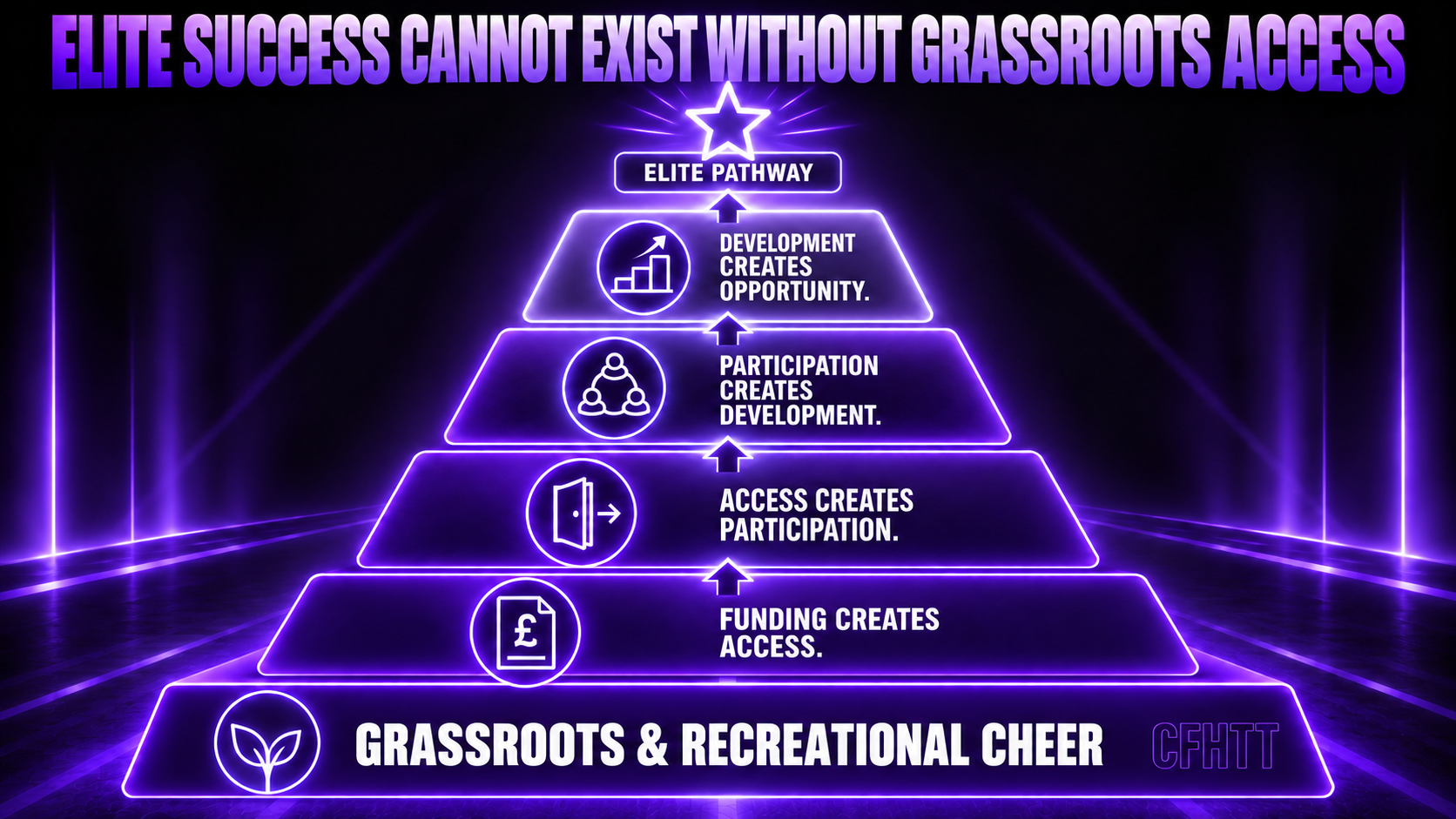
The wider the entry point into the sport, the greater the potential talent pool becomes. Grassroots development and elite success therefore should not be competing priorities. One feeds the other.
The next 12 months will give us clues. The next five years will tell the story.
There is a temptation when something this significant happens to immediately ask what has changed.
That is understandable. But it may also be the wrong timescale.
Over the next 12 months, I will be interested to see.
- What does SCE’s promised FAQ clarify?
- What happens around coach education ?
- What funding opportunities become accessible?
- Do relationships with schools, universities and local authorities begin to develop?
Those will give us early indicators. But judging the success of NGB recognition after one year would be premature.
Building sporting infrastructure takes time. The real impact may be much clearer five years from now than twelve months from now. And that requires something from the cheer community too:
Patience. Not passive acceptance. Not an absence of questions. Informed patience.

CFHTT Insight: Recognition was the goal. Impact is the next test.
SportCheer England deserves credit for reaching this point.
People have spent years doing the less visible work required to move cheerleading towards formal recognition, much of it voluntarily.
That deserves to be honoured. Now comes the hard part in my opinion.SportCheer England has to turn recognition into relationships, opportunities, systems and, eventually, outcomes that people within the sport can experience. We should give them the time and grace required to do that. But we should also keep looking at the bigger picture.
For me, the measure of success cannot only be what happens at the elite end of English cheerleading.
Medals matter. International representation matters.
Elite pathways matter.
But so does whether more children can enter the sport.
- Whether coaches can access meaningful development.
- Whether grassroots clubs can become more sustainable.
- Whether programmes can access facilities and investment.
Whether talented athletes from different communities can progress because the pathway is accessible enough for their talent to be discovered in the first place.
The top of the pyramid can only be as strong as the foundation beneath it.So I don’t see August 2026 as the moment the work was completed. I see it as the point at which almost a decade of work earned English cheerleading the opportunity to begin something bigger.
Celebrate that.
Give SportCheer England time to build. Keep asking constructive questions.And, above all, keep the whole sport in view. Recognition has opened the door.
What English cheerleading builds on the other side of it will define the next chapter.
And that is what CFHTT will be watching.
Read Next

Discover more from The UK's number one Cheerleading Blog
Subscribe to get the latest posts sent to your email.
