Many cheerleaders in the UK will have now had their first comp or two of the season. And doesn’t it feel fabulous to be back on the mat, in front of the judges, in uniform and with your whole programme cheering you on? Great, right? For some, however, comps can be really stressful and anxiety-provoking. In this article we’re going to talk about the highs and lows of competing, and give away some tips to make sure you’re next comp is your best yet! We’ll explore some basic fundamentals, but then some mindset tips too.
First of all, you have the preparation. You know the phrase, the failure to prepare is preparing to fail – or something like that. So in order to be the best version of yourself, the best member of your team, we need to ensure that you are well prepared. So, let’s start with the basics. Are you eating and sleeping well? By that, I mean are you eating full meals and getting a full night’s sleep?
The good thing about exercise is that it helps with our routine and in turn our sleeping pattern. But it can be really easy to go to bed on time yet sit scrolling through your phone. We know just how easy it is to fall down that explore page rabbit hole. All the professionals say it’s best not to go on your phone right before bed because the lights on your phone affect your ability to sleep (or something much more scientific, but that’s ultimately what they mean). I’m not going to sit here and say you can’t go on your phone before bed, because ultimately, I’d be a hypocrite. What I do is schedule time to be on my phone before my ideal sleep time, and ensure I have it on that night time mode, where the blue lights are reduced so it’s got a bit of an orange tint. Either way, just make sure you’re getting your rest. Without your rest, your body can’t recover and fill you with the energy to perform at your best.
Off the back of that is food. Ultimately, we need to make sure we’re eating full and balanced meals to ensure we’re fuelling our bodies with enough energy to train and compete at our optimum levels. However, it’s never as simple as just that, is it? We belong to an aesthetic sport and our uniforms can often show parts of our body that naturally carry the most fat. We also use our bodies in a completely unique way in jumping, tumbling and stunting. And for some people, those mindsets and thought patterns play into their diet. If that’s something that makes you feel uneasy, you are not alone. I could sit here and teach you about the importance of an athlete’s diet until the cows come home. I don’t want to sit here and teach people to suck eggs or insult their intelligence. If this is something that plays on your mind, Beat, the eating disorder organisation have a number of resources on their website you may benefit from. They also have a telephone helpline, email and chat rooms to speak to one of their professionals for advice. If in doubt, check them out for non-judgemental advice. I’ll link their detail below. Remember, you’re a cheerleader, they don’t get much better than us!
Moving onto that winning mindset. Now it’s so easy to fall into the negative mindset trap, comparing uniforms, comparing the amount of support you have to another programme, comparing facilities, elite stunt sections, etc. We’ve all been there, we all know what I mean. So you’ll also likely be familiar with the phrase: comparison is the thief of joy – I’m all about the quotes today.

You don’t get extra points for having the sparkliest uniform or whether you train on a sprung floor or not, you get your points for what you put out on the comp floor. So put on your tunnel vision and instead of focusing on what you haven’t got, think about how amazing all the things you have got are, practise some gratitude. We have to think about the things that are in our control. We don’t have control over anyone else but you and your team. For the most part, you have control over the words that come out of your mouth and the thoughts in your head, so let’s talk about that.
Of course, we need to practise. You don’t need me to tell you that, you train every week. But outside of training, we can be listening to the music, marking the routine in your head on the bus, stretching and conditioning at home. Aside from the physical practise, how do we train our minds for competition? Well we need to ensure we are the best we can be. If you are the best version of yourself and you give everything you’ve got, even if something falls or you don’t get the placing you were hoping for, you know there was nothing more you could have done because you gave it your all. That’s when we (hopefully) are at peace with ourselves. So we’re eating enough, we’re sleeping well, we’re practising at every opportunity, how do we make sure we have the right mindset?
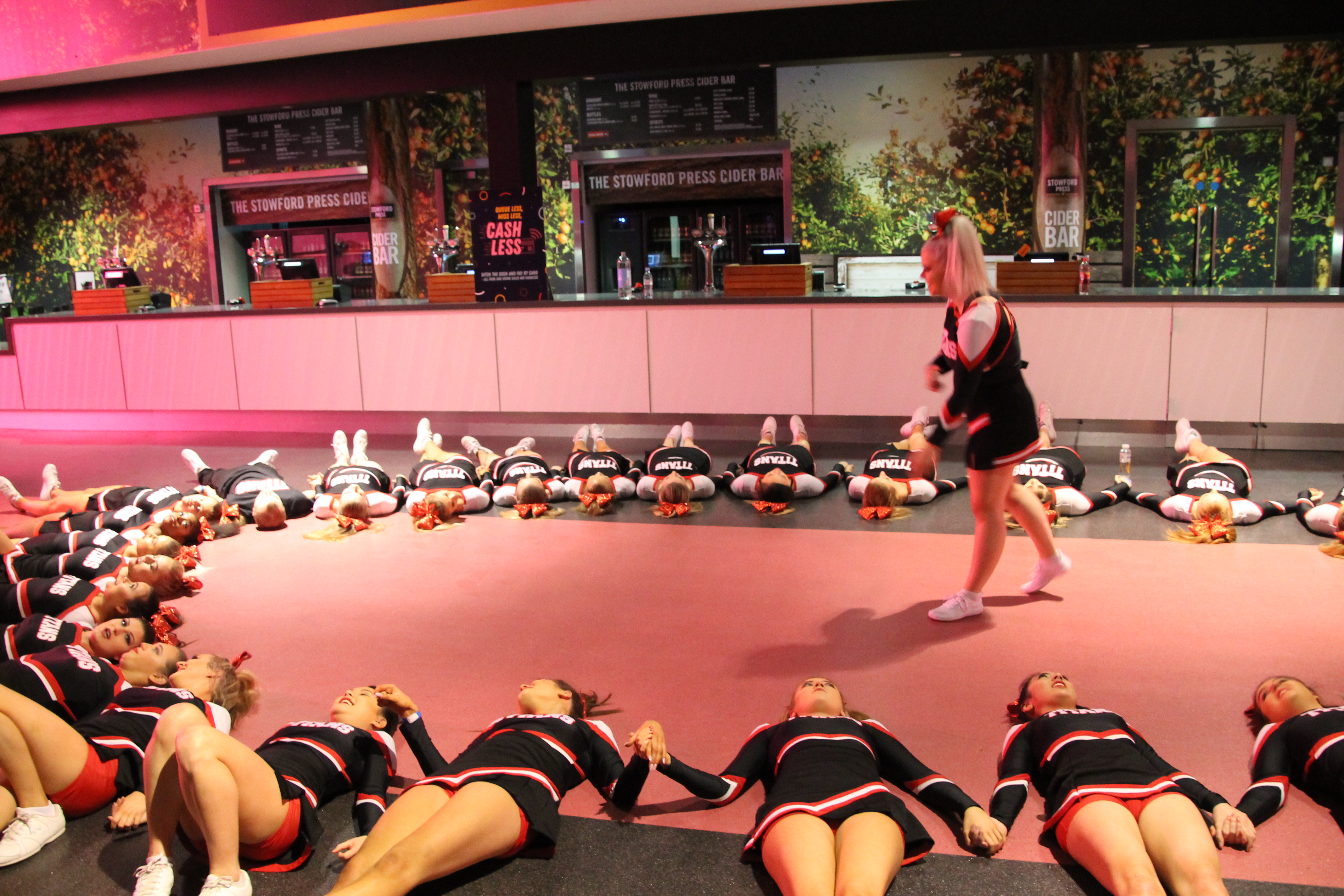
The easiest way to start is with imagery. A lot of teams are doing this now at comp which is great to see. Have you ever lay in that circle, holding hands with your speaker in the middle, listening to your music playing and performing the routine in your head? Gives me chills just thinking about it! Well, I don’t just want you to do this on comp day. Closing your eyes and performing the routine has so many benefits. Imagery helps us stay focused on the task at hand rather than those pesky negative thoughts. If we’re imagining our full out, we’re imagining us hitting, not falling. It helps build our confidence and reduce anxiety. When we hit our stunt or tumble pass, we feel joy, right? So imagery replicates that joy, without that feeling of imminent death when you finish your full out (I can’t be the only one). Of course, when thinking about the routine, you can still sing along, give your facials, you can feel your the muscles that should be moving in that instance. If I come home feeling deflated after struggling with a new stunt sequence, the next day or the day I’m next due in the gym, I’ll perform it mentally in my head a few times. Of course in my head I’m as good a flyer as Gabi Butler, so I hit every time. It gives me the confidence to think, you know what, next training session I’ve got this, I know what I’m doing and we’re going to smash it. Imagine doing that once or twice a week. You’ll reduce those pesky negative thoughts like “last time this happened”, basically those WHAT IF thoughts, and instead you’ll focus more on what will hit, WHAT WILL happen.
So we’ve gone back to Barney the dinosaur’s playhouse, our imagination is fantastic. But now it’s comp day and the nerves are kicking back in. What do I do now? Well I’m going to take you back to a (slightly relevant) memory of my GSCE maths class. It was the day before the exam and we were staying after school stressing doing mock papers thinking we were going to fail. Our maths teacher simply said “if you don’t know it now, you never will”. So at first glance you think, oh fantastic I’m doomed to fail. But then I realised, ok, I’m unlikely to learn anything new in the next 18 hours, so what is stressing about it going to do other than put me in a bad mood? Generally speaking, when you arrive at the venue for your competition, it’s all the hard work you’ve done in the lead up to the competition that matters. Practise makes permanent, so whatever you’ve practised will likely reflect on the floor.
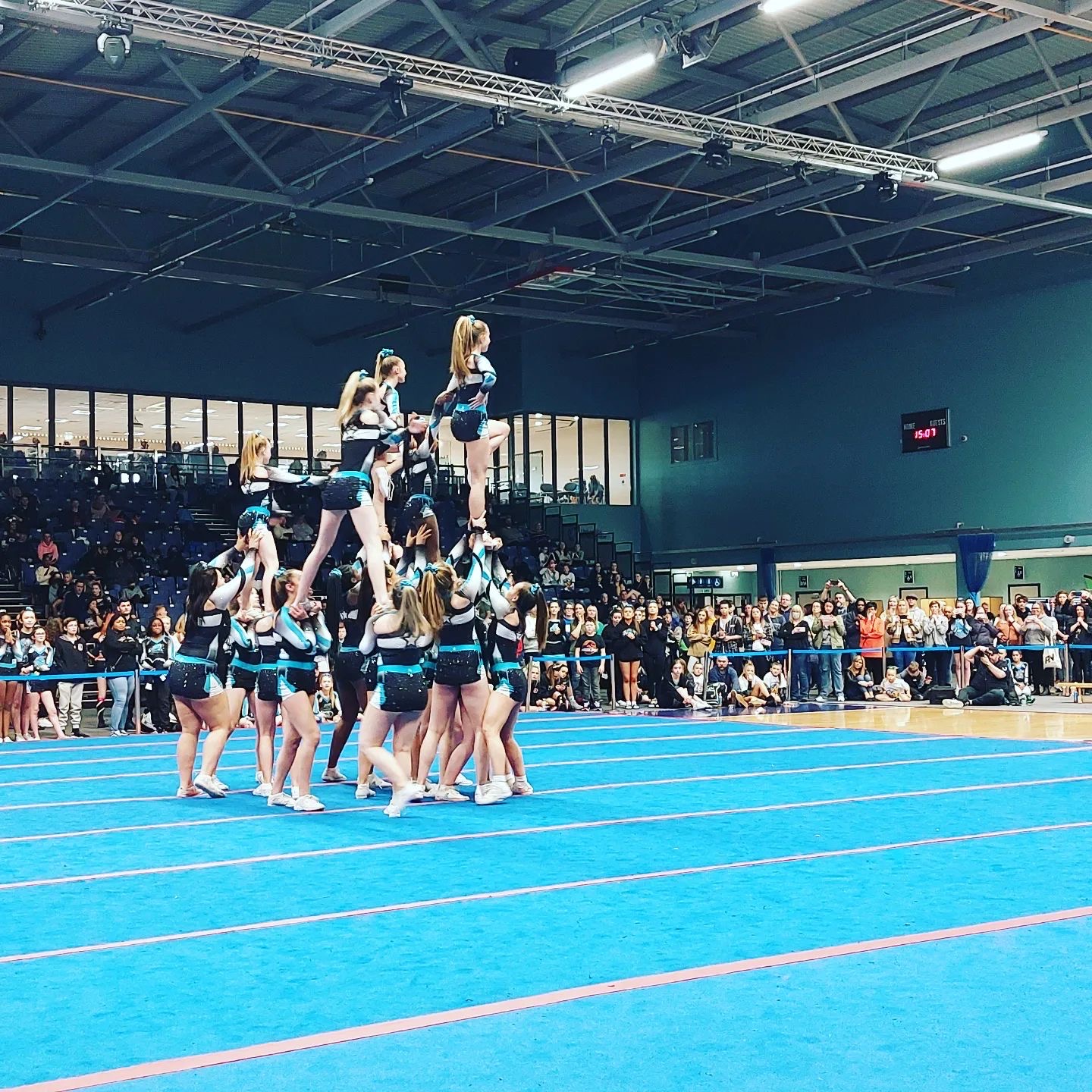
Have you ever been in warm up and your usually seamless routine seems to be falling to pieces? Everyone is freaking out, you’re feeding off each other’s stress and you’re all just want to get it over and done with. That’s not how comps should be. You train all season, you put in all the hard work, the blood, sweat and tears for a measly 2.5 minutes. ENJOY IT. Sometimes stunts fall. Yes, it’s heartbreaking, but all it means is that it’s just not your day, it’s someone else’s. If you walk onto the comp floor with the weight of the world on your shoulders because your stunt fell, your jumps were out of time, you flopped your tumble pass and you can feel your coach’s death stare piercing through your very existence; naturally, it’s going to become a self-fulfilling prophecy and even if you hit, you’re going to feel pants. Alternatively, if you walk onto that floor thinking, “you know what, I’ve put in all the hard work up to this point, I love my teammates, I love cheerleading, and we’re going to showcase who we are for better or for worse” I bet you’ll enjoy that 2.5 minutes so much more. Naturally, when we’re all enjoying ourselves, we’re feeding off each other’s positive energy, we’re pushing harder, we’re performing and the judges see that. Whether you win the trophy or you come dead last, the things you remember long-term are the emotions and bonds you had.

But what do we do when the negative emotions start creeping in? I tend to use a couple of grounding techniques. Sometimes we get all up in our head so I just remember to feel the floor, whether that’s with my feet, stamping or jumping on the ground, or physically placing both my hands on the ground, it reminds me that I’m here in my body and keeps me present. Sounds a bit weird so I’ll move onto some more common grounding techniques.
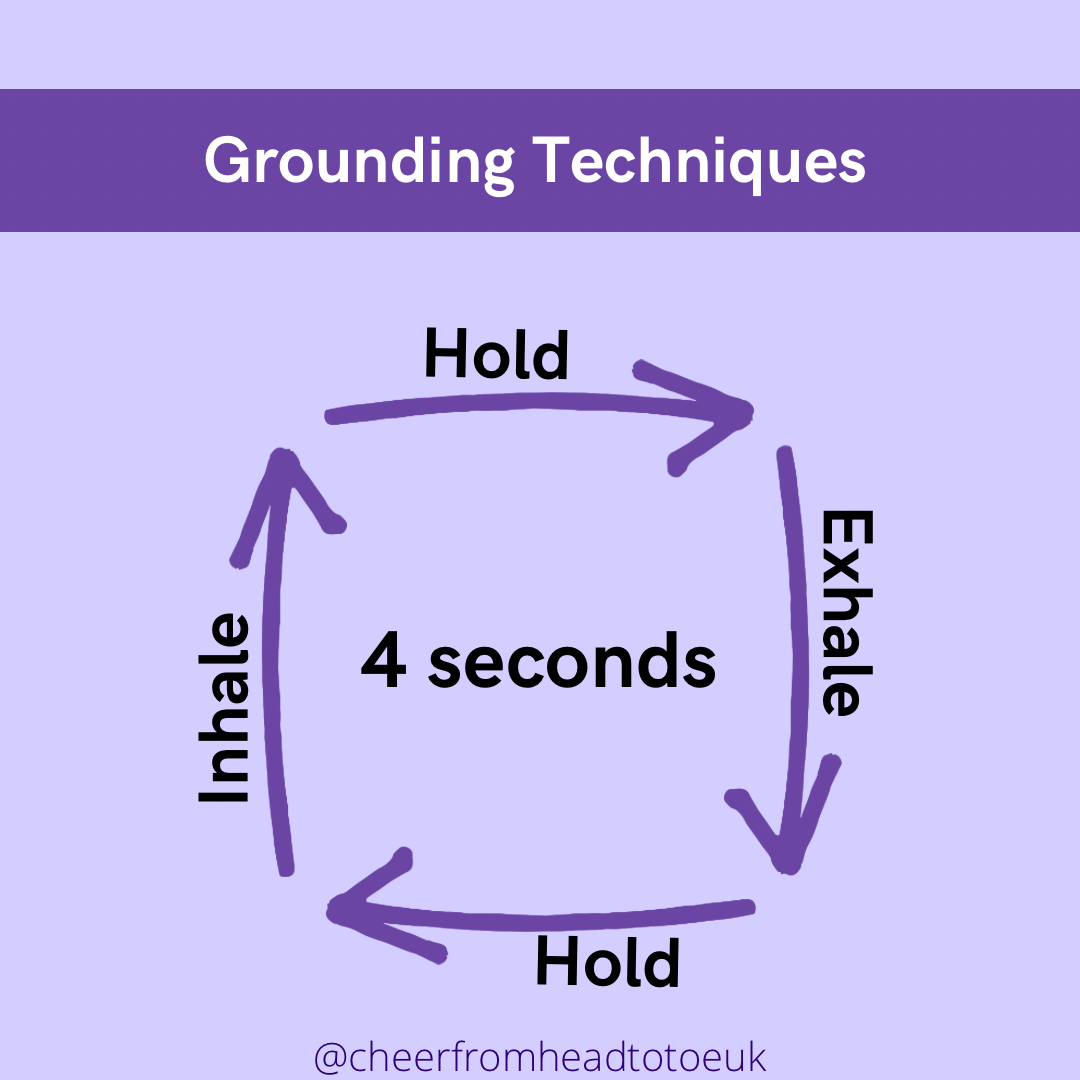
Box breathing can be useful if you’re someone who benefits from breathing exercises. You start by doing a heavy exhale getting as much air as you can out of your lungs. Then, breath in for a count of four, make sure you’re breathing into your tummy, hold your breath for a count of four, and then slowly exhale for a count of four, then hold your breath for a final count of four. Repeat this a few times. This can help ensure you’re present in the moment when you get thoughts racing around your head and it can also help with your concentration.
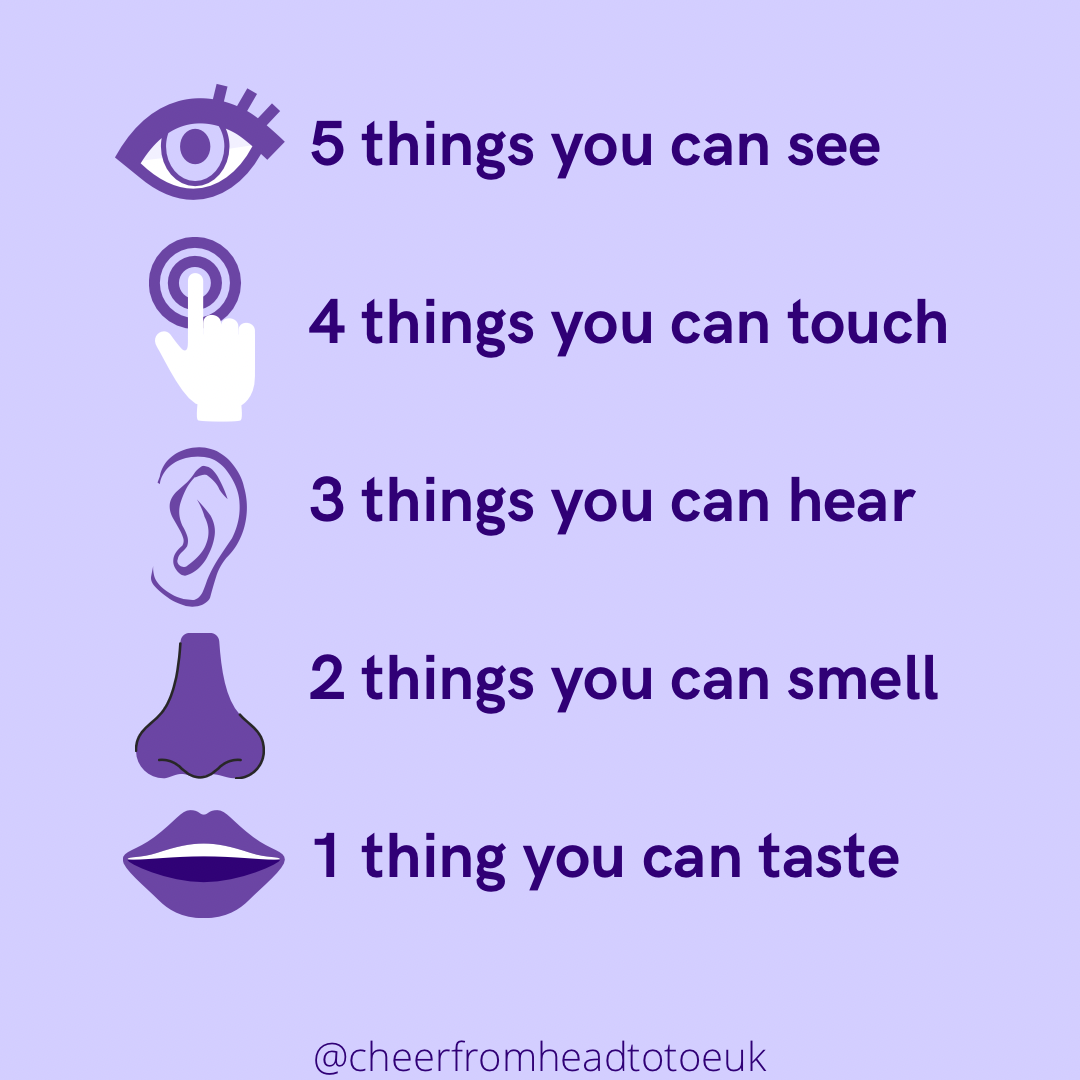
Another common grounding technique is the 5-4-3-2-1 method using your senses. Start by acknowledging five things you can see around you. Another person, a chair, a water bottle, a light fitting, a fire exit sign maybe. Next, acknowledge four things you can touch, perhaps your shoe, bow, floor, hand rail. Then, acknowledge three things you can hear, for example, the music playing, someone talking, shoes running across the floor. Acknowledge two things you can smell, like hairspray or sweat (lets be real here). Finally, acknowledge one thing you can taste, whether that’s water, the last thing you ate or your plain old tongue. So five things you can see, four you can touch, three you hear, two you can smell and one you can taste. It helps us remain present and empties your mind of the racing thoughts.
These techniques are best practised when you’re not in a heightened state of anxiety or stress. Once you’ve perfected them in a relaxed state, it becomes easier to use when your anxiety levels rise. Like everything, these techniques aren’t for everyone. I used to hate box breathing but now I can use it well. But have a Google, or even check out YouTube for some grounding techniques that may work for you.
It’s so easy to get caught up in hitting zero, placing first, winning a bid. It’s important to set goals and aim high. Just remember, we’re human. If today isn’t your day, maybe tomorrow will be, maybe next comp or the one after. The main thing is you’re safe and you’re enjoying yourself. If your best friend was feeling anxious, nervous or stressed, what would you say to them? And then take your own advice.
And that’s me over and out for the next month. If you have anything you’d like us to cover, let us know! Best of luck in your upcoming competitions and remember to tag us in all of your photos and videos.
Take care,
Rach x

97% of people who follow CFHTT website enjoy following our social media platforms
@Cheerfromheadto
Discover more from The UK's number one Cheerleading Blog
Subscribe to get the latest posts sent to your email.
