
Every UK cheerleading season, one of the most influential documents is quietly published and shapes the future of hundreds of cheerleading programmes across the UK.
The SportCheer UK age grid.
On the surface, SportCheer UK (SCUK) Age Grid can appear to be little more than an administrative document.
In reality, for coaches and programme owners, the structure of the coming season is dictated by this document . The release of the annual Age Grid signals the start of planning for the season ahead.

Team structures begin to take shape.
- Birth years are checked
- Athletes are moved into divisions.
- . Team structures begin to take shape..
The release of the annual Age Grid signals the start of planning for the season ahead.
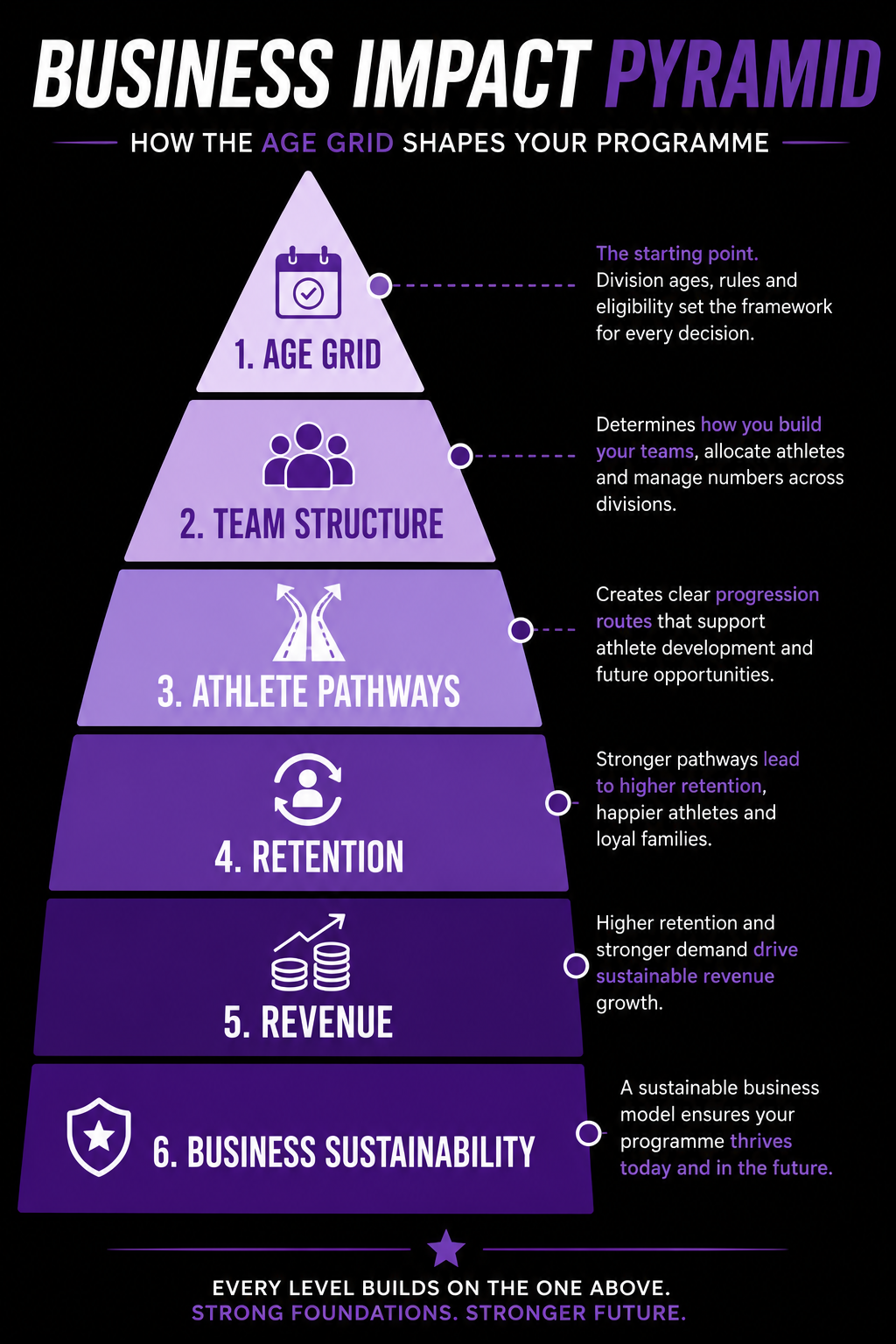
For many programmes, particularly smaller clubs, age grids do not simply determine where athletes compete.
- They influence roster construction
- athlete retention
- programme growth
- in some cases, whether a team can exist at all.
Get Free Coach Resources. Get exclusive coaching resources, competition updates & educational content delivered directly to your inbox.
When SportCheer UK released its 2026–2027 Competition Divisions and Age Grid, many coaches likely went straight to the tables to search for birth years, division names, and eligibility changes.
Initially, there appears to be relatively little need for concern.
There is no major restructuring of the competition system.
No sudden removal of major divisions. No fundamental departure from previous seasons.
However, focusing solely on what changed risks missing the bigger picture.
The 2026–2027 Age Grid provides valuable insight into where SportCheer UK believes the sport is heading and how the governing body is attempting to balance two competing priorities.
The first is supporting the realities of the domestic competition market.
The second is continuing the long-term transition towards greater alignment with international standards.
Those two objectives currently coexist.
The question programme owners should be asking is whether they will always be able to.
UK Cheerleading’s Steady March Towards International Alignment
The front-page change this season is the adjustment of Prep, Novice and Stunt Group ages to mirror the IASF age structure.
This was not unexpected.
SportCheer UK has spent several seasons gradually aligning domestic divisions with international standards and had already indicated this move was coming.
From a governance perspective, the decision makes complete sense.
The closer domestic divisions mirror international structures, the easier it becomes for athletes, coaches and programme owners to understand progression pathways. It reduces confusion around eligibility and creates greater consistency between domestic and international competition opportunities.
As UK and Irish programmes continue to increase their presence on the international stage, alignment becomes increasingly important.
The modern cheerleading athlete is more likely to have aspirations that extend beyond domestic competition.
Yet alignment is rarely painless.
Large programmes often have the athlete numbers needed to absorb age-grid changes with relatively little disruption.
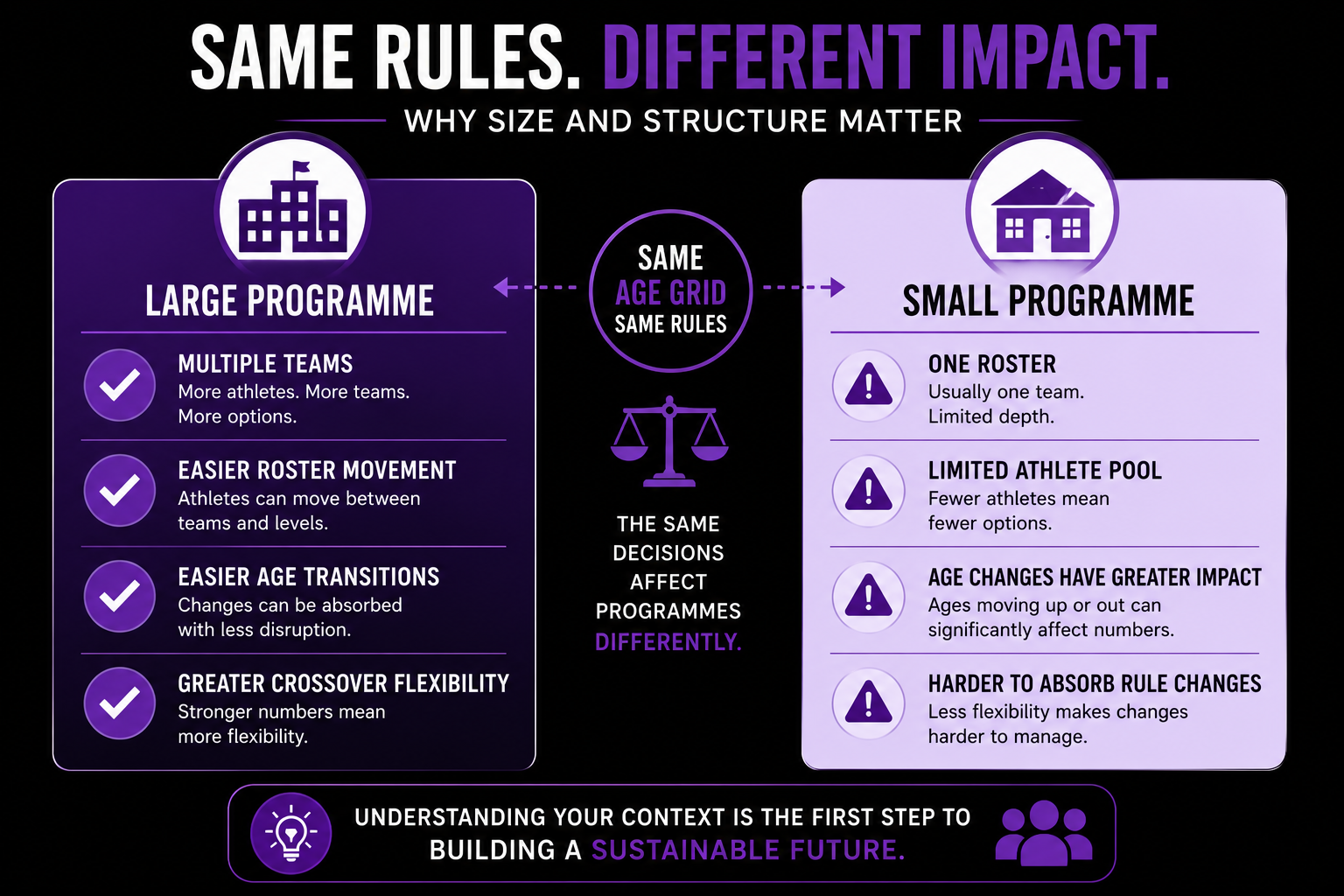
Smaller rural clubs, university programmes and single-team gyms do not always have that luxury.
A seemingly minor adjustment to age eligibility can have significant consequences for roster planning. In some cases, it can be the difference between fielding a team and losing one altogether.
Take the 10-year age spread restriction in Senior divisions (such as Senior Prep and Senior All-Star Elite)
While such measures support athlete welfare, they can create genuine challenges for smaller programmes that rely on wider age ranges to maintain viable team numbers.
This is why age grids matter.
They are not simply technical documents.
They are business documents that may affect the business model.
The challenge facing SportCheer UK is finding a way to modernise the system without destabilising the programmes that have spent years building the foundation of the sport.
The 2026–2027 Age Grid suggests they remain acutely aware of that challenge.
The Survival of U10 and U14 Tells an Interesting Story
Perhaps the most revealing decision in the entire document is not what changed, but what remained.
Both U10 and U14 divisions have been retained.
Originally introduced as transitional divisions to help programmes adapt to the new age structure, many expected these divisions to eventually disappear once clubs had adjusted.
Instead, SportCheer UK has extended them again.
That decision speaks volumes.
It suggests coaches have embraced these divisions rather than merely tolerated them. It also suggests SportCheer UK is actively listening to the needs of programmes as the sport evolves.
More importantly, it demonstrates that participation data appears to be influencing policy.
The governing body seems willing to prioritise practical programme needs over rigid adherence to international structures.
However, this creates both short-term opportunity and long-term uncertainty.
The opportunity is obvious. Teams that have found success within U10 and U14 structures can continue operating without disruption.
The uncertainty comes from the fact that these divisions remain uniquely British.
While nobody can say with certainty what the age grid will look like in five or ten years’ time, the overall direction of travel appears clear. The UK continues to move closer towards international alignment.
If that trend continues, programme owners should begin considering how future changes might affect their athlete pathways, recruitment strategies and team structures.
The most successful clubs are rarely those that react to change.
They are usually the ones preparing for it before it arrives.
New Prep Divisions Reflect a Changing Market
The introduction of additional Prep levels and a new U16 Novice division may appear like relatively small additions.
In reality, they reveal something much larger.
A decade ago, many programmes operated within a relatively narrow range of divisions and athlete expectations.
Today, coaches are managing athletes with vastly different expectations, financial circumstances, commitment levels and goals.
Not every athlete wants an Elite pathway.
Not every family can commit to the financial and training demands associated with high-level competition.
Not every programme has the athlete numbers required to sustain multiple Elite teams.
Expanding Prep and Novice opportunities cater to these realities.
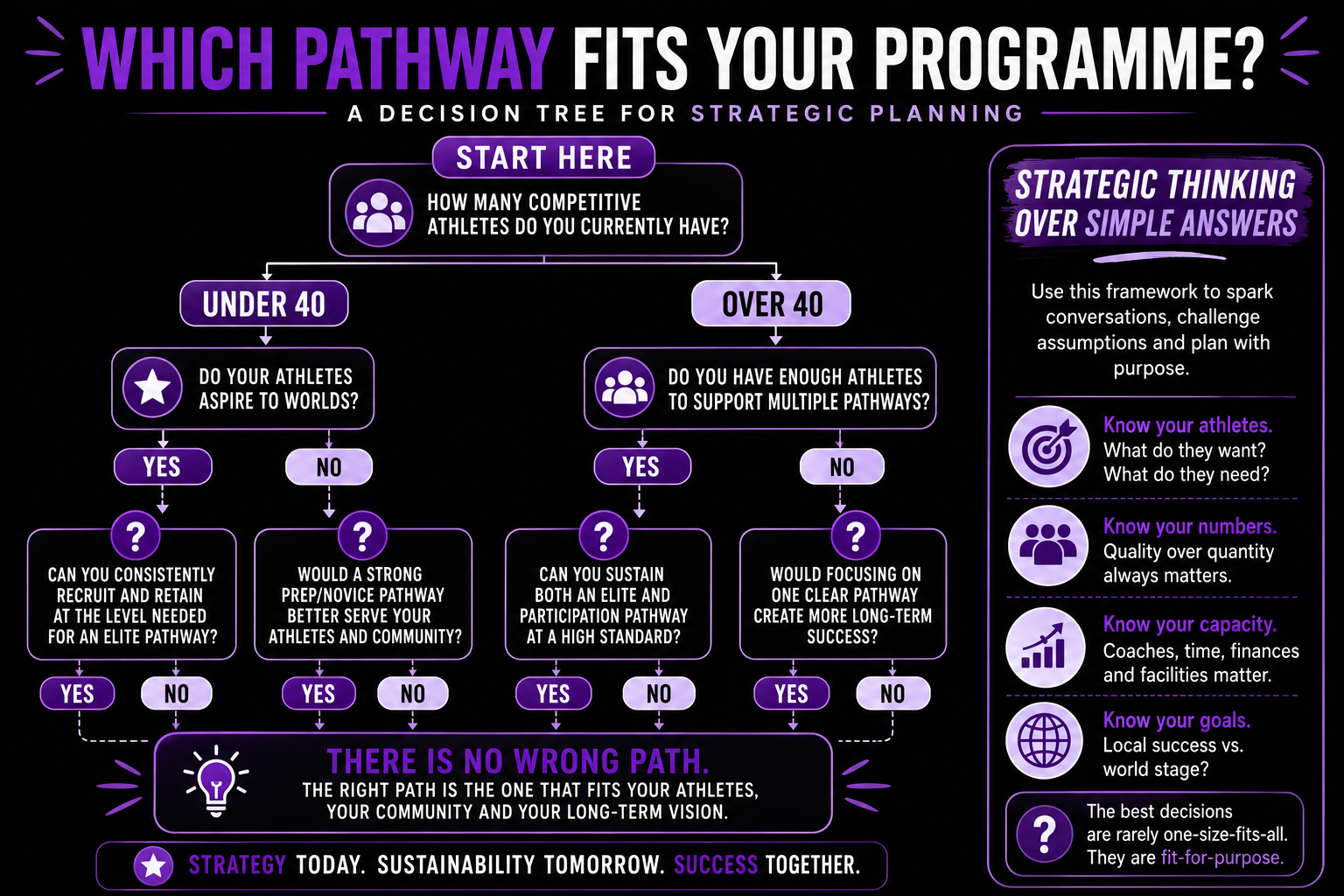
Two Athlete Pathways Are Beginning to Emerge
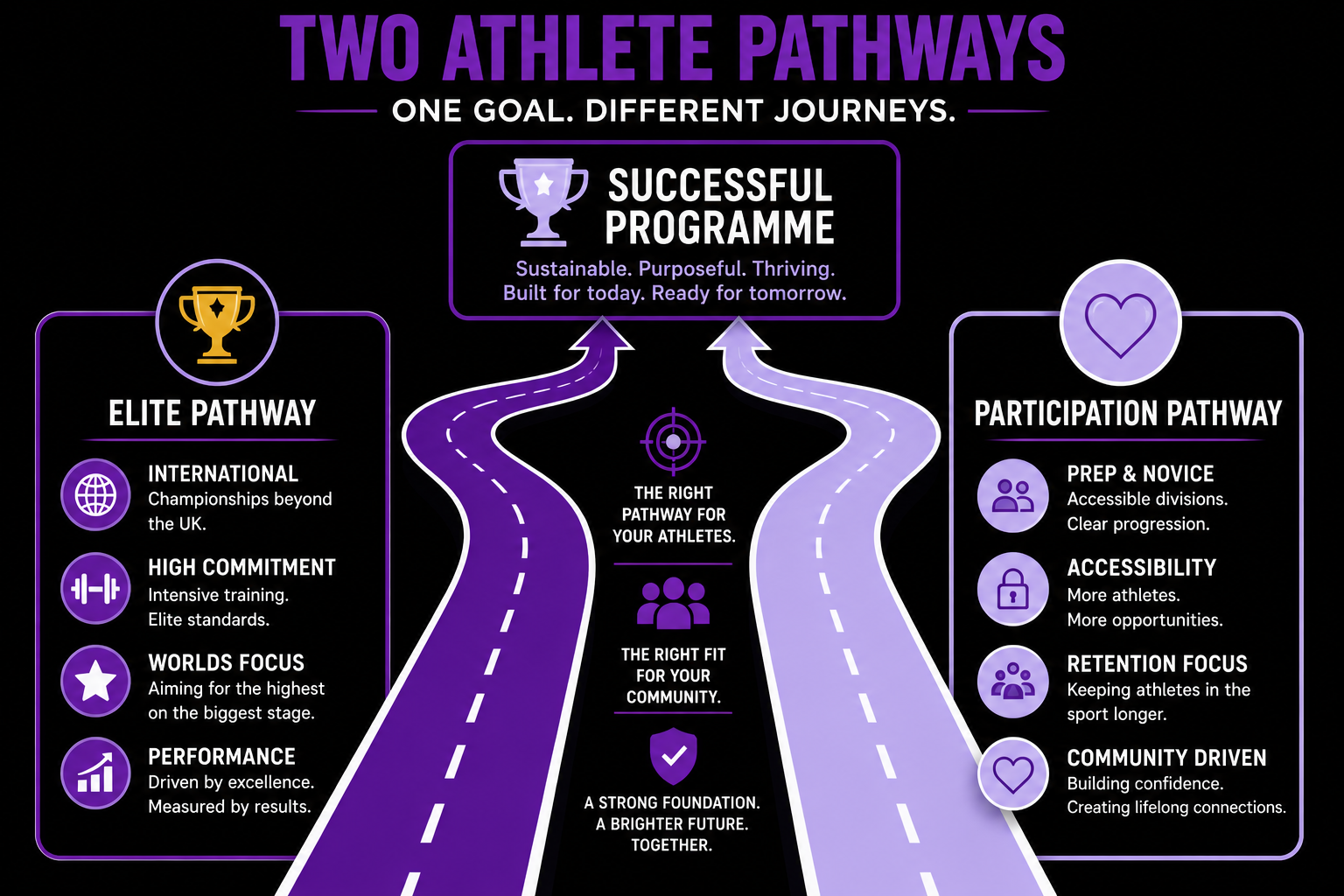
The evolution of the sport of recent season highlights emergence of two distinct athlete pathways
The first will be programmes focused on elite pathways and international competition.
The second will focus on accessibility, participation and long-term athlete retention through Prep and Novice opportunities
Both pathways speak to different Families and athletes and may appear to require different business models and coaching philosophies.
The strongest programmes won’t necessarily choose one or the other.
They’ll design a pathway that reflects the needs of their local community.
For example
A programme with 80 athletes may choose to operate both an Elite pathway and a strong Prep pathway, while a programme with 25 athletes may find greater long-term success by focusing on one clearly defined pathway rather than attempting to offer every division.
For programme owners, this may be one of the most commercially significant developments within the entire document.
The ability to offer multiple progression points creates more opportunities to retain athletes who might otherwise leave the sport altogether.
In an increasingly competitive leisure market, athlete retention may prove just as important as athlete recruitment.
Success in the next decade may be defined less by how many Worlds teams a programme produces and more by how effectively it builds sustainable athlete pathways.
The Real Warning Sign: Crossovers
Buried within the document is what may prove to be the most significant long-term development of all.
SportCheer UK has strengthened its language around crossovers and now recommends athletes compete no more than one level above or below their primary team.
At present, this remains guidance rather than a rule.
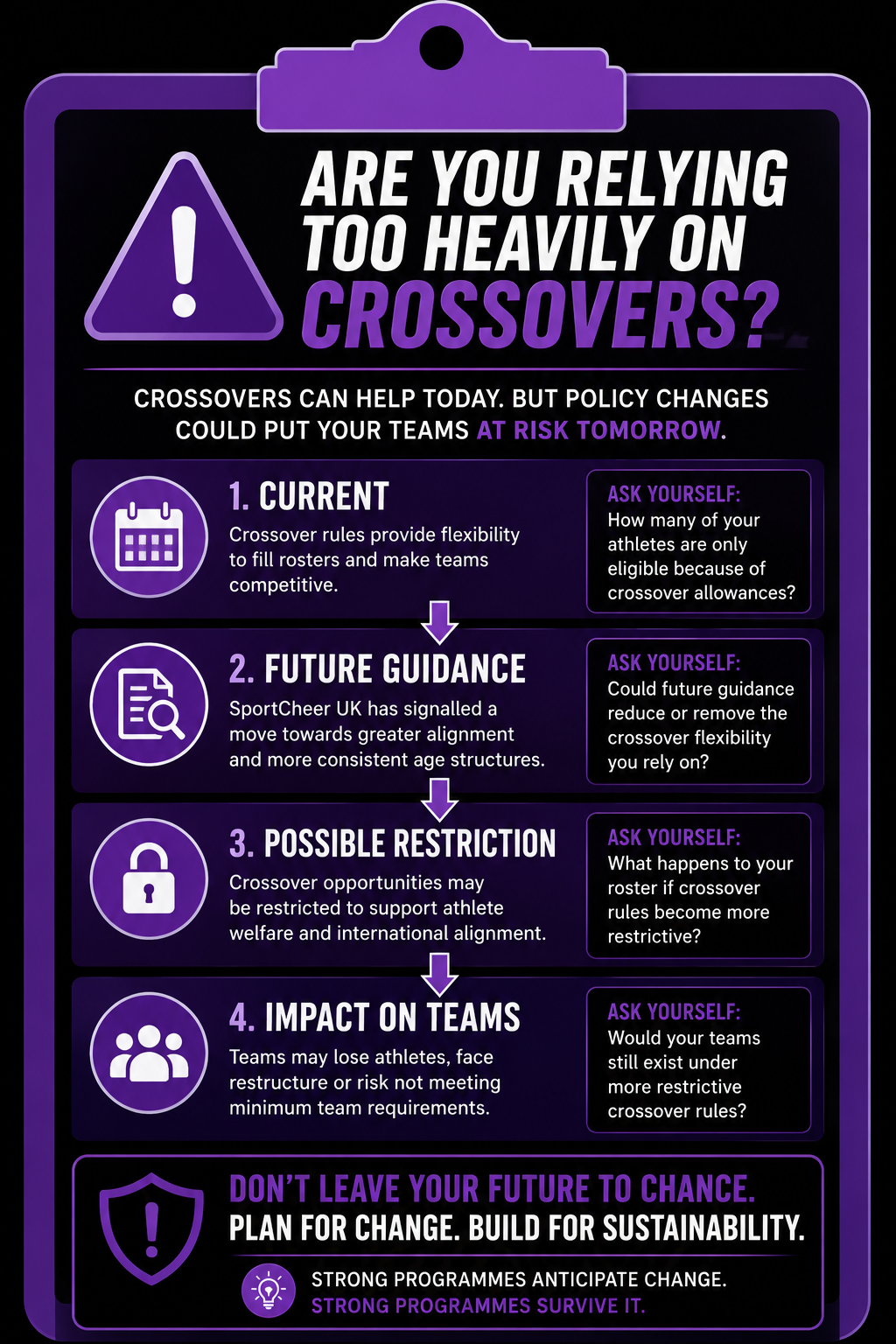
However, the document also indicates that restrictions may be introduced in future seasons.
Programme owners should pay close attention.
For years, crossovers have helped clubs maximise participation opportunities, field additional teams and manage roster shortages.
For some programmes, crossover-heavy structures have become an essential part of their operating model.
Yet crossover reliance also creates challenges.
Athlete fatigue increases.
Training schedules become more complex.
Competitive balance becomes a topic of debate.
Roster management becomes increasingly difficult.
From SportCheer UK’s perspective, limiting crossovers may be viewed as a way to encourage stronger and more sustainable team structures while creating greater competitive integrity.
For some programmes, however, such restrictions would require a fundamental rethink of how their business is built.
The message is clear.
Coaches should not assume today’s crossover flexibility will exist forever.
For many programmes, the question is no longer whether crossover policies could change, but whether their current team structures could withstand those changes if they do


Is UK Cheerleading Entering Its Professional Era?

Viewed individually, many of the changes within the 2026–2027 Age Grid appear relatively minor.
Viewed collectively, they tell a different story.
Alignment with international standards.
Expanded athlete pathways.
Greater structure around progression.
Growing discussion around crossover management.
All of these points towards a sport that is becoming increasingly organised and increasingly professional.
The UK cheerleading community has spent much of the last decade focused on growth.
Participation has increased.
International representation has expanded.
Competitive opportunities have multiplied.
The next challenge may be creating a framework capable of supporting that growth long term.
This is where the tension between domestic flexibility and international consistency becomes most visible.
Domestic development often requires adaptation.
International alignment often requires standardisation.
At some point, those priorities may come into conflict.
The exact timing remains unclear, but the trajectory is increasingly obvious.
The age grid suggests SportCheer UK is attempting to navigate that challenge carefully.
What This Means for Programme Owners and coaches
The 2026–2027 Age Grid feels less like a finished destination and more like a roadmap toward what comes next.
The retention of U10 and U14 demonstrates flexibility.
The alignment of Prep and Novice ages demonstrates uniformity.
The crossover guidance suggests preparation for future structural changes.
Together, these decisions reveal a governing body attempting to balance the realities of today’s sport with the demands of the future.
For coaches, the immediate impact may be relatively small.
For programme owners, however, the document offers valuable insight into how UK cheerleading may evolve over the next five to ten years.
The most successful programmes will not simply ask where their athletes fit today.
They will ask where the sport itself is likely to be in the distant future.
Because the coaches and programme owners who benefit most from change are rarely those who react to it.
They are the ones who create protocols and procedures to transition to the new era with ease.
CFHTT Strategic Insight
The biggest mistake coaches could make
The Age Grid is often viewed as a technical document an administrative tool . In reality, it has a much bigger impact and reveal much bigger story.
It reveals how a governing body intends to shape the future of its sport.
The biggest mistake coaches could make is viewing the 2026–2027 Age Grid as simply another set of eligibility rules.
Viewed in isolation, this year’s changes appear relatively modest.
Viewed over several seasons, however, a clear pattern begins to emerge.
SportCheer UK is gradually moving the domestic competition structure closer to international standards while attempting to protect the accessibility that has helped UK cheerleading grow for decades.
Those two priorities currently complement one another.
They may not always do so.
Programme owners who wait until future changes become mandatory may find themselves reacting under pressure.
The programmes most likely to thrive over the next decade are unlikely to be those with the biggest athlete numbers today.
They are more likely to be those already thinking about adapting their business model to
sustainable athlete pathways, succession planning, recruitment strategies and how their team structures might need to evolve as the sport landscape develops.
The age grid does not simply tell us where athletes can compete next season.
It offers a glimpse into what UK cheerleading landscape may become and how this will affect your current business model. The question is no longer whether UK cheerleading will continue to develop .The question is which programmes will evolve with it.
Read next
Discover more from The UK's number one Cheerleading Blog
Subscribe to get the latest posts sent to your email.

2 thoughts on “2026-2027 SportCheer UK Competition Divisions & Age Grid: Explained”